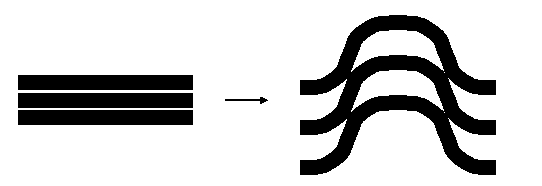
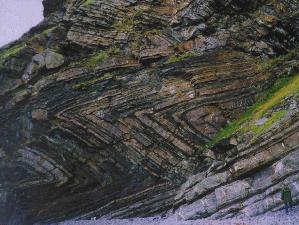
 Multilayered structures have a tendency to form patterns with straight limbs
and sharp hinges, as shown in the picture on the right.
Since the rock is believed to behave elasticly during the deformation,
this is surprising. Think of a ruler, or an eraser - if you bend or buckle
one of these, it takes on a nicely smooth curved shape, not a sharp
hinge. This localization of the deformation into hinges is a consequence
of the multilayered structure.
The first step in understanding this phenomenon is by taking a stack of
layers, and buckling them without allowing any change in thickness:
Multilayered structures have a tendency to form patterns with straight limbs
and sharp hinges, as shown in the picture on the right.
Since the rock is believed to behave elasticly during the deformation,
this is surprising. Think of a ruler, or an eraser - if you bend or buckle
one of these, it takes on a nicely smooth curved shape, not a sharp
hinge. This localization of the deformation into hinges is a consequence
of the multilayered structure.
The first step in understanding this phenomenon is by taking a stack of
layers, and buckling them without allowing any change in thickness:
|
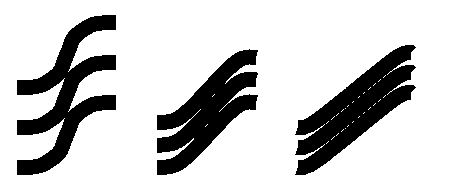 |
In geological structures the overburden pressure (the pressure in the rock that is due to the column of rock above) is large, preventing voids from forming. The idea depicted in the figures above demonstrates how the deformation should be localized in order to reduce the void space.
In summary, the overburden pressure limits the amount of voids that can open during deformation. As a result, sharp hinged patterns are favoured above rounded ones.